Discover

How to find outlier YouTube videos in your niche

A step-by-step for using Eden to find the YouTube videos that genuinely outperformed in your niche, plus what to study once you have them.

·6 min read

Most YouTube research tools surface the biggest videos and call them viral. Eden surfaces the real viral wins: the videos that broke through what their channel typically gets, regardless of channel size. Those are different lists, and the second one is where the lessons live.

This article covers what makes a YouTube outlier worth studying, the four-step workflow for finding them, and the patterns that drive most of them.

Why outliers beat raw views

A 2 million view video on a channel where typical videos get 5 million is a normal video for that creator. A 200,000 view video on a channel where typical videos get 10,000 is a once-a-quarter event. The second video did something the channel's other videos did not. The first did not.

Sorting YouTube by raw views finds you the first kind. You learn very little from it, because what you are seeing is mostly audience size. Sorting by outlier multiplier finds you the second kind. The lesson is in there.

The four-step workflow

  1. 01

    Filter Discover to YouTube

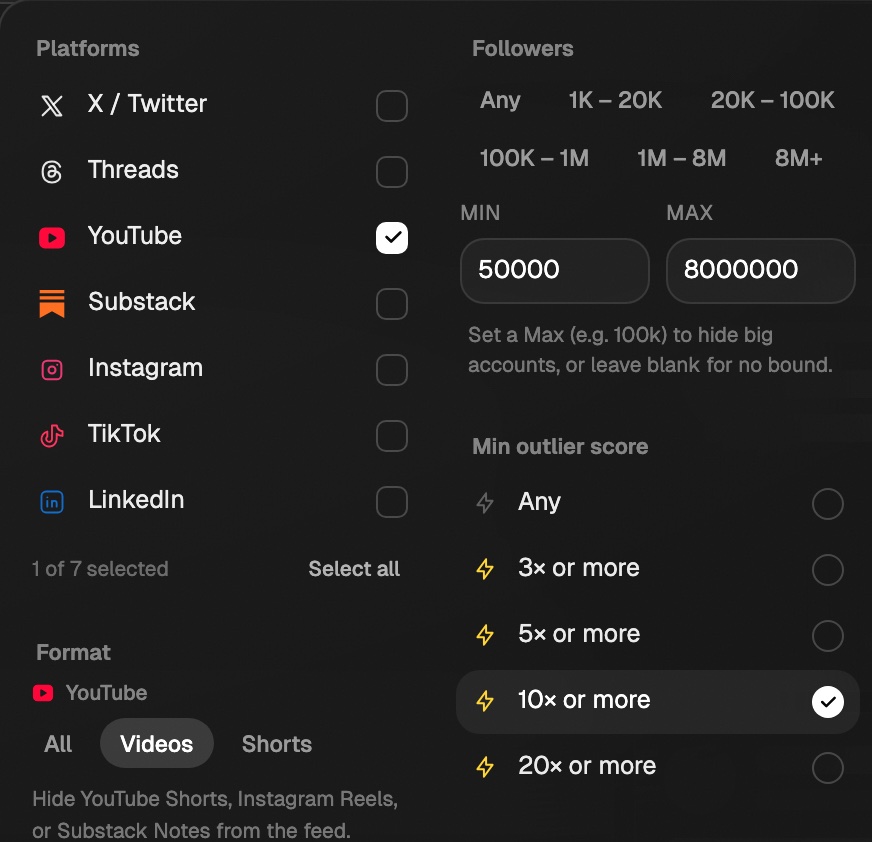
    Open Discover. In the Platforms dropdown, deselect everything except YouTube. The feed now shows only YouTube outliers.

  2. 02

    Click the pillar you write in

    Use the chip strip above the search input to narrow the feed to one pillar (Productivity, Cooking, Marketing, etc.). If you have not pinned the pillar you want yet, click + Add to add it.

  3. 03

    Bump the outlier minimum

    Discover already floors at 5×. For real studying, open the Outlier filter and set it to 10× or more. You lose some volume and you gain signal. Anything 20× and above is worth reading carefully.

  4. 04

    Save the strongest videos to a board

    For each one, open the video and ask one question: what did this do that the channel's other videos did not? Save the videos where the answer is clear. Read boards as swipe files for the discipline that keeps the board useful.

The whole loop takes 10 to 20 minutes a day if you make it a habit. After two weeks you have a board of 30 to 50 outlier videos in your niche, and the next time you sit down to plan a YouTube video you start from there.

If you want to study creators at your own audience size, set the Audience filter to the follower range that matches yours. Watching what is breaking through for 5K-to-20K channels when you are at 8K teaches you more than watching what works for 5M channels.

Studying one specific YouTube creator

If you have a creator in mind, the workflow is different. Inside Discover, click the Creators tab and search the creator by name or channel URL. Their profile shows every video Eden has indexed for them, with a sort dropdown:

  • Recent. Newest videos first.
  • Top liked. Weighted engagement (likes plus comments plus shares, with views as a tiebreaker).
  • Top viewed. Sorted purely by view count.
  • Top outlier. Posts that overperformed for that creator, ranked by the multiplier.

For studying, Top outlier is the one you want. It surfaces the videos this specific creator broke through with, regardless of how big or small they are. Top viewed tells you which videos got the most absolute reach, which on a fast-growing channel mostly tells you which videos are most recent. Top outlier tells you which videos earned their reach.

Save the strongest from any creator's profile to the same niche board you build from Discover, so the swipe file mixes "what is hitting in my pillar this week" with "what this specific creator I admire keeps getting right."

What drives most YouTube outliers

YouTube's outliers come from a small number of patterns. None of these are guarantees. They are the variables that move the needle more often than the others.

Title

The most-tested variable on YouTube. A channel where typical videos get 10K views and posts an outlier is almost always running a different title shape. Common tells:

  • A specific number where competitors used a vague word ("3 mistakes" instead of "common mistakes")
  • A first-person hook where competitors used third-person ("I tried" instead of "you should")
  • A counterintuitive claim where competitors used an obvious one
  • A title that works as a sentence rather than a tag

Reading 20 outlier titles in your niche is one of the highest-leverage things you can do as a YouTuber. The shape becomes obvious.

Thumbnail

A close second. Outlier thumbnails on YouTube tend to do one of three things:

  • Show one human face making one strong expression
  • Use very few words, in very large type
  • Lead with a single object or contrast that the title pays off

Save outlier thumbnails to a swipe-file board. After you have 20, scan them as a grid. The shared traits become hard to miss.

Topic angle

Sometimes the title and thumbnail are unremarkable and the video still performs. Open it and watch. Usually the video is taking a familiar topic from an unfamiliar angle, or pairing a familiar angle with a new framework. The angle is the lesson, not the production.

Hook (first 30 seconds)

Outliers usually open differently than the channel's median videos. They get to the point faster, they make a stronger claim earlier, or they show the result before the explanation. Watch the first 30 seconds of every outlier you save. The hook is portable.

Avoid the obvious traps

A few things to watch for:

  • Sponsored videos. Some outliers are paid promotion or cross-channel pushes. The multiplier counts views the same way regardless. If a video has the look and feel of a sponsored upload (an integration, a brand-led format, a creator promoting their own product), discount it when you study. It did not earn the multiplier the way an organic video did.
  • One-time topical events. A video about a sudden news story can hit 20× and never reproduce. Note these and move on. Patterns that repeat matter more than one-off spikes.
  • Channel pivots. Sometimes a creator pivots to a new niche and their first video on the new topic outperforms their old work. The lesson here is the pivot, not a tactic. Useful, but rarely portable.

Where to go next

Still stuck?

Email us. A real person reads every message.

Tell us what you tried and where you got stuck. We answer within one business day.

[email protected]